




No products in the cart.
new-18%On Sale
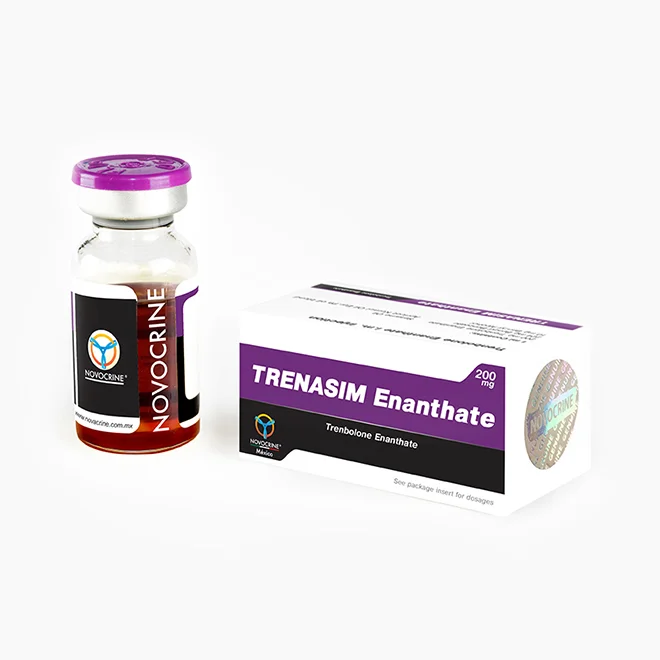
Trenbolone E 200 mg 10 ml NV: Best USA
Trenbolone E 200 mg 10 ml NV – Novocrine is an injectable trenbolone enanthate product presented at a concentration of 200 mg/ml in a 10 ml vial. The enanthate ester gives it a longer-release profile than trenbolone acetate, while the product remains centered on the same underlying anabolic-androgenic compound, trenbolone.
Original price was: 120.00$.99.00$Current price is: 99.00$.
Description
Tren E (Trenbolone Enanthate): How It Differs From Trenbolone Acetate
Trenbolone enanthate, commonly called Tren E or Trenbolone E, is an esterified form of trenbolone. It belongs to the same chemical family as trenbolone acetate, or Tren A, but carries a different ester attached to the underlying steroid. Structural research confirms that these are distinct ester forms—not two unrelated anabolic compounds.
The most useful comparison therefore concerns delivery over time: how a formulation releases the drug, how exposure develops, and how long exposure may continue after administration stops.
Those differences matter, but they do not establish that enanthate builds a different type of muscle, guarantees fewer side effects, or produces better results than acetate.
This article provides educational information. It does not establish a bodybuilding dosage, cycle, or individualized treatment plan.
Is Trenbolone E the Same as Trenbolone Enanthate?
Yes. Trenbolone E and Tren E refer to trenbolone enanthate. “Enanthate” identifies the ester; the underlying steroid is trenbolone. Its chemical name also uses heptanoate, another name for the same ester group.
Tren E is not testosterone enanthate
The shared word enanthate does not make two drugs equivalent.
Testosterone enanthate contains testosterone attached to an enanthate ester. Trenbolone enanthate contains trenbolone attached to that ester. They remain different drug substances, with different biological properties and different evidence bases. A testosterone-enanthate label or clinical trial cannot establish a Tren E treatment regimen.
Tren E is also different from trenbolone hexahydrobenzylcarbonate
Enanthate, acetate, and hexahydrobenzylcarbonate are separate esterified forms of trenbolone. Their names should not be used interchangeably, even when a seller groups them together as “long-acting trenbolone.” Chemical identity comes first; a marketing nickname does not replace it.
Trenbolone Enanthate vs Acetate: The Main Differences
| Comparison | Trenbolone enanthate — Tren E | Trenbolone acetate — Tren A |
|---|---|---|
| Underlying steroid | Trenbolone | Trenbolone |
| Attached ester | Enanthate, also called heptanoate | Acetate |
| Molecular formula | C₂₅H₃₄O₃ | C₂₀H₂₄O₃ |
| Molecular weight | Approximately 382.5 g/mol | Approximately 312.4 g/mol |
| General formulation profile | Longer-acting depot profile | Shorter-acting profile relative to enanthate |
| Expected exposure after stopping a comparable depot formulation | More prolonged | Less prolonged |
| Proven superiority for human muscle growth | Not established | Not established |
| Does the ester establish safety? | No | No |
The chemical distinctions are well documented. The release comparison reflects steroid-depot pharmacology and experimental evidence, not a controlled human trial establishing exact equivalence between commercial Tren E and Tren A products. Formulation and administration conditions can also affect exposure.
What Does the Enanthate Ester Actually Change?
It changes the delivery profile, not the identity of trenbolone
Esterification modifies the physical properties of a steroid molecule. In an oil-based depot formulation, those properties can affect how readily the drug leaves the injection site and becomes available systemically.
This principle is established for other injectable androgens. For example, prescribing information for testosterone esters explains that esterification reduces polarity and that absorption from an intramuscular oil phase occurs slowly. That illustrates the depot principle; it does not supply an exact half-life for trenbolone enanthate.
For Tren E, the relevant distinction is consequently extended delivery of the same underlying androgen, rather than the creation of a new muscle-building mechanism.
The formulation matters alongside the ester
“Enanthate” alone does not describe every factor controlling a product’s behavior.
In a randomized human study of nandrolone esters, researchers found that the ester, injection site, and injection volume influenced circulating drug concentrations and physiological effects. Although nandrolone is not trenbolone, the study demonstrates why an ester name cannot completely specify an injectable product’s pharmacokinetics.
A comparison that ignores the carrier formulation, concentration, actual contents, and administration conditions risks attributing every difference to the ester.
Longer release is a trade-off
A longer-lasting depot can spread drug delivery over a longer period. The corresponding limitation is that stopping further administration does not remove drug already present in the depot.
Applied to Tren E, a more persistent exposure profile is a pharmacological inference, not proof that every adverse effect will last a particular number of days. Drug concentrations, tissue responses, and recovery can follow different timelines. Experimental Tren E research demonstrates sustained exposure in rodents, while human research with other androgen esters shows that formulation affects the duration of physiological suppression.
Trenbolone Enanthate Half-Life: What Research, Pharmacology, and Theoretical Models Suggest
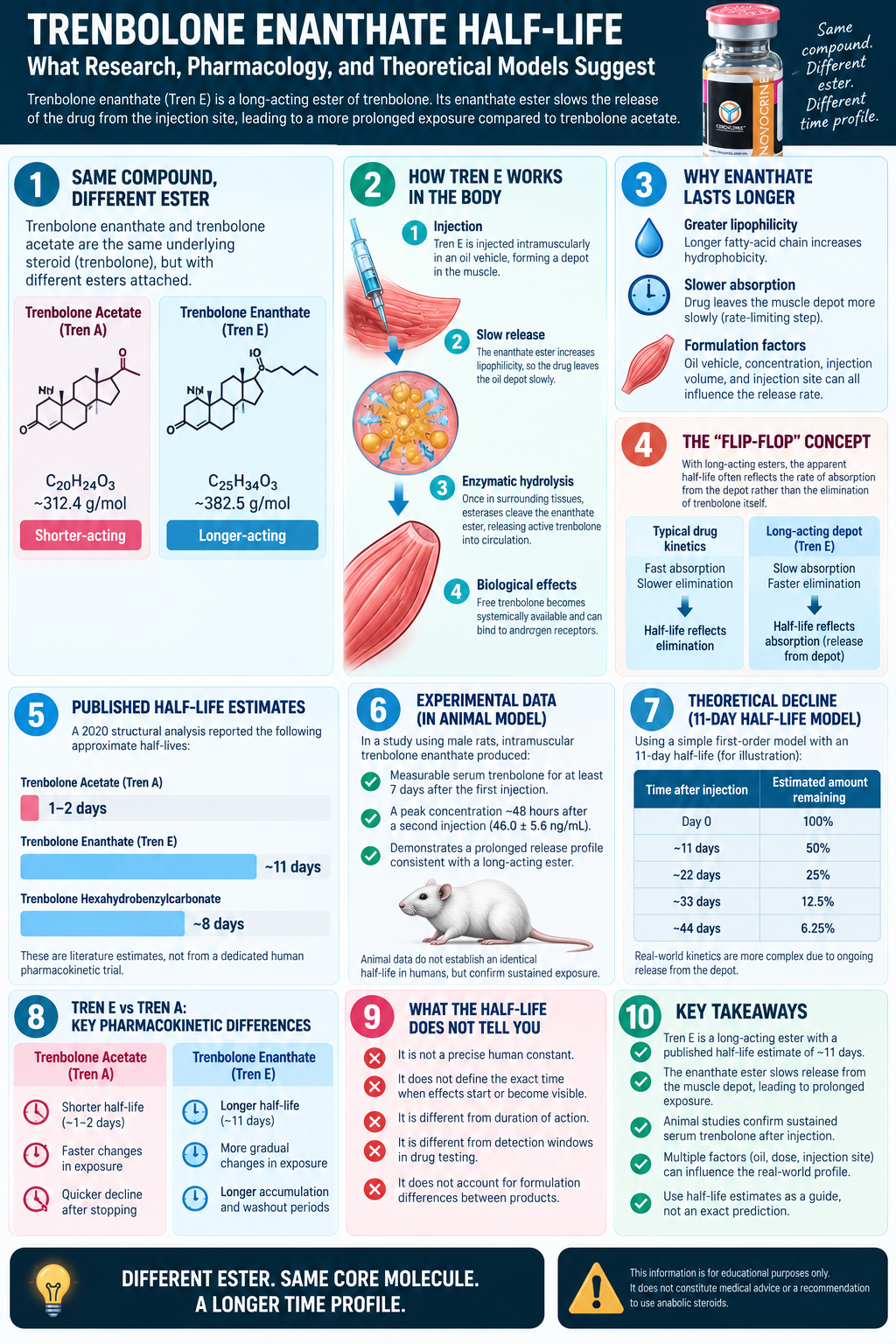
The half-life of trenbolone enanthate is commonly described as being substantially longer than that of trenbolone acetate. This difference is pharmacologically plausible and is supported by what is known about injectable androgen esters: attaching a longer, more lipophilic ester to the 17β-hydroxyl group slows the rate at which the steroid leaves an oil depot after intramuscular administration. Once the esterified molecule reaches aqueous tissues and circulation, esterases can cleave the ester and release active trenbolone. (ncbi.nlm.nih.gov)
A 2020 peer-reviewed structural analysis of trenbolone and its esterified derivatives describes trenbolone acetate as having a reported half-life of approximately 1–2 days and trenbolone enanthate as approximately 11 days, with trenbolone hexahydrobenzylcarbonate falling between them at roughly eight days. These values are useful as literature estimates, but the paper was a structural investigation rather than a dedicated human pharmacokinetic trial designed to measure Tren E elimination after a standardized injection. (sciencedirect.com)
Therefore, approximately 11 days is a reasonable published estimate to discuss for Tren E, provided it is labeled correctly: it is a secondary literature estimate rather than a precisely established human pharmacokinetic constant.
Why the Enanthate Ester Makes Tren E Longer-Acting
The major difference between Tren E and Tren A begins before free trenbolone even reaches systemic circulation.
Injectable anabolic-steroid esters dissolved in oil form a depot inside muscle tissue. The esterified steroid gradually partitions from the hydrophobic oil phase into surrounding interstitial fluid. Longer fatty-acid esters generally increase lipophilicity, which slows this transfer.
This principle is well established in androgen pharmacology. Endotext describes injectable androgen esters as depot prodrugs whose release rate depends heavily on ester hydrophobicity, side-chain length, oil vehicle, injection volume, and injection site. Once the ester leaves the depot, nonspecific esterases hydrolyze it and release the parent androgen. (ncbi.nlm.nih.gov)
The same basic phenomenon has been demonstrated experimentally with several long-acting lipophilic drugs: increasing ester lipophilicity can increase absorption half-life and plasma residence time because release from the oil depot becomes the rate-limiting step. (pmc.ncbi.nlm.nih.gov)
Conceptually:
Trenbolone enanthate in oil → slow release from muscular depot → ester enters tissue fluids → enzymatic hydrolysis → free trenbolone becomes systemically available
That is fundamentally different from assuming that an injected Tren E molecule instantly releases free trenbolone and that the body then takes 11 days to metabolize it.
The Important Concept: Tren E May Show “Flip-Flop” Pharmacokinetics
Long-acting injectable esters are especially interesting because the number commonly called their “half-life” may reflect absorption from the depot more than elimination of the free parent steroid.
Pharmacologists describe this situation as flip-flop kinetics.
Normally:
absorption is fast → elimination is slower → terminal half-life mainly reflects elimination.
With a long-acting depot:
release/absorption is slow → elimination of released drug may be faster → terminal concentration decline can largely reflect continued release from the injection depot.
This is why saying “trenbolone itself has an 11-day half-life” is chemically imprecise.
A better formulation is:
Trenbolone enanthate can produce a prolonged apparent exposure profile because its enanthate ester retards release of the trenbolone prodrug from an oil depot.
Research on injectable anabolic-androgenic steroids supports this general depot model. Reviews describe esterification at the 17β position as increasing the oil/water partition coefficient, slowing escape from the injection site and prolonging systemic exposure. (frontiersin.org)
We Actually Have Experimental Tren E Concentration Data
Importantly, Tren E is not supported only by theoretical extrapolation from testosterone esters.
Joshua Yarrow and colleagues directly investigated intramuscular trenbolone enanthate in male Fischer 344 rats. In a pilot pharmacokinetic experiment, animals received trenbolone enanthate at baseline and again seven days later, with blood collected every two days.
The researchers found that serum trenbolone remained elevated throughout the seven days following the first injection. After the second injection on day seven, measured serum trenbolone reached a peak of 46.0 ± 5.6 ng/mL on day nine, approximately 48 hours later. (journals.physiology.org)
That experiment is much more informative than simply saying “Tren E is long acting.”
It demonstrates experimentally that:
- an intramuscular Tren E depot can continue supplying measurable trenbolone for at least a week in that animal model;
- concentrations do not necessarily peak immediately after administration;
- another exposure added seven days later produced a higher subsequent concentration;
- the release profile is prolonged enough to sustain circulating trenbolone between widely separated sampling points.
The experiment does not establish an 11-day human half-life—the subjects were rats—but it directly confirms the qualitative pharmacokinetic behavior expected from an enanthate depot.
What the Rat Concentration Curve Tells Us About “Kick-In Time”
The experimental concentration curve also helps correct another common oversimplification: the idea that Tren E somehow remains inactive for several days before suddenly “kicking in.”
That is not what the animal data suggest.
Serum trenbolone increased after administration and remained measurable across the observation period. The approximately 48-hour post-second-injection peak in that particular experiment reflects a concentration maximum, not the moment when trenbolone suddenly becomes biologically active. (journals.physiology.org)
There are therefore at least four different events that bodybuilding discussions often combine under the phrase kick in:
1. Release from the oil depot
The esterified compound begins leaving the injection site.
2. Appearance of trenbolone in circulation
Ester hydrolysis makes active parent trenbolone systemically available.
3. Pharmacodynamic signaling
Androgen-receptor-dependent biological effects occur.
4. Visible or subjective changes
Changes in muscle size, body composition, performance, sleep, libido, or other noticeable outcomes may develop later.
Those processes occur on different timelines.
A person not noticing a visible physique change immediately does not imply that the compound has been pharmacologically inactive until that point.
Where Does the Frequently Quoted 11-Day Tren E Half-Life Come From?
The approximately 11-day figure is not purely an internet-forum invention.
As noted above, Borodi and colleagues’ 2020 paper in the Journal of Molecular Structure explicitly describes trenbolone enanthate as having a half-life of approximately 11 days, compared with approximately 1–2 days for acetate. (sciencedirect.com)
What needs to be stated carefully is the level of evidence behind the number.
The publication does not report a controlled human pharmacokinetic experiment in which subjects received standardized Tren E injections and investigators calculated an 11-day terminal half-life from serial plasma measurements. The number appears as part of the paper’s pharmacological background.
Therefore should neither:
pretend that 11 days is a precisely established human constant,
nor
pretend that no scientific literature gives a Tren E half-life estimate.
The appropriate statement is:
Published secondary literature places the Tren E half-life at approximately 11 days, while direct experimental animal evidence confirms prolonged delivery. A rigorous human pharmacokinetic trial establishing one universal value has not been identified.
That tells the reader what is actually known instead of simply refusing to discuss the number.
A Theoretical 11-Day Half-Life Model: What Would the Decline Look Like?
If we temporarily accept 11 days as an apparent half-life for modeling purposes, first-order exponential decay provides a useful way to visualize persistence.
After one half-life, approximately half of the relevant exposure component remains. After another half-life, half of that remainder remains.
Under this simplified theoretical model:
| Time after reference point | Theoretical fraction remaining |
|---|---|
| Day 0 | 100% |
| ~11 days | 50% |
| ~22 days | 25% |
| ~33 days | 12.5% |
| ~44 days | 6.25% |
This is not a measured Tren E human concentration curve. It is what a simple one-compartment first-order model predicts if an 11-day apparent half-life is assumed.
Real intramuscular Tren E would be more complicated because drug may still be entering circulation from the depot while other molecules are simultaneously being distributed and eliminated.
That means a real curve is better represented by:
depot release + absorption + ester hydrolysis + distribution + elimination
rather than by a single exponential line.
This distinction becomes particularly important with long-acting esters because an oil depot can create an extended “tail” of exposure.
Why Five Half-Lives Does Not Mean the Drug Suddenly Disappears
Another common misconception is that a compound is completely gone after a specific number of half-lives.
Using the same simplified 11-day model:
after one half-life → ~50% remains;
after two → ~25%;
after three → ~12.5%;
after four → ~6.25%;
after five → ~3.1%.
The decline is exponential rather than a countdown to zero.
Therefore, an estimated half-life is useful for understanding relative persistence, but it should not be treated as an exact date at which the compound ceases to exist biologically.
Why Tren E Accumulates More Readily Than a Short Ester
A long apparent half-life has another consequence: new exposure can occur before previous exposure has completely declined.
This produces accumulation.
Imagine that a depot is still releasing Tren E while another depot is introduced later. The new concentration profile is added on top of residual exposure from the previous one. With repeated exposures, concentrations can therefore rise toward a higher average level before reaching an approximate equilibrium between input and elimination.
This is a general pharmacokinetic principle, not a Tren E-specific bodybuilding protocol.
The rat experiment provides a useful illustration. Serum trenbolone remained elevated through the first seven-day interval, and after another Tren E exposure at day seven, concentrations subsequently reached the study’s measured peak. (journals.physiology.org)
That observation is consistent with overlapping exposure from a persistent depot, although it should not be converted directly into a human administration schedule.
Why Steady State Would Take Longer With Tren E Than Tren A
For a drug following approximately linear pharmacokinetics, repeated exposure usually approaches steady state over several apparent half-lives rather than immediately.
If the 11-day Tren E estimate were approximately correct, a theoretical model would predict that accumulation and decline occur over a substantially longer period than with an ester whose apparent half-life is around 1–2 days.
This is one of the most meaningful practical pharmacological differences between Tren E and Tren A.
It means that Tren E should theoretically produce:
slower changes in average exposure → greater persistence → longer accumulation and washout periods.
Tren A should theoretically produce:
faster changes in exposure → less prolonged accumulation → faster decline after the depot stops supplying drug.
Those are pharmacokinetic differences.
They do not demonstrate that Tren A produces “better cutting” or that Tren E produces “better bulking.”
Molecular Structure Also Explains Why the Esters Behave Differently
The distinction can be seen directly at the molecular level.
Free trenbolone has a molecular weight of approximately 270.4 g/mol. PubChem describes esterification as a strategy used to increase trenbolone’s effective duration, with ester conjugates being cleaved to release free trenbolone. (pubchem.ncbi.nlm.nih.gov)
Trenbolone acetate has a molecular weight of approximately 312.4 g/mol, whereas trenbolone enanthate is approximately 382.5 g/mol.
This has two consequences.
First, the larger enanthate ester increases lipophilicity and favors a longer depot-release profile.
Second, the ester itself contributes molecular mass.
Purely stoichiometrically, the trenbolone portion represents approximately:
86.5% of trenbolone acetate’s molecular mass
versus
70.7% of trenbolone enanthate’s molecular mass.
This does not provide a human dose conversion or establish equivalent effects. It simply demonstrates chemically why comparing equal milligram numbers of two esterified products is not equivalent to comparing identical amounts of the parent trenbolone molecule.
Why Oil, Concentration, Injection Site, and Formulation Can Change the Real Half-Life
Even if two products both contain trenbolone enanthate, their pharmacokinetic profiles do not necessarily have to be perfectly identical.
Research on injectable androgens shows that depot release can be affected by:
- ester lipophilicity;
- oil vehicle;
- solvent composition;
- drug concentration;
- injected volume;
- injection site;
- local blood flow;
- formulation characteristics.
A review of injectable testosterone pharmacology notes specifically that longer ester side chains slow absorption because they increase hydrophobicity, while vehicle viscosity, drug concentration, volume, and injection site can further alter absorption kinetics. (academic.oup.com)
The principle is not restricted to testosterone. A human pharmacokinetic study of nandrolone esters demonstrated that ester type, injection site, and injection volume could materially alter systemic pharmacokinetics. (pubmed.ncbi.nlm.nih.gov)
That provides an important reason not to treat 11.0 days as if it were a universal physical constant applicable to every underground Tren E formulation.
A more realistic model is a range around an expected long-acting profile, with formulation-dependent variation.
Why Testosterone Enanthate Is Useful as a Model—but Not as a Substitute
Testosterone enanthate should not be used to claim that Tren E has exactly the same half-life.
However, dismissing testosterone-enanthate research completely also throws away useful pharmacological information.
Both compounds contain a steroidal 17β-hydroxyl group esterified with enanthic/heptanoic acid, and extensive human testosterone research demonstrates the fundamental depot behavior of this ester class.
Endotext explains that the seven-carbon enanthate side chain produces substantially longer delivery than short esters because of its greater hydrophobicity. (ncbi.nlm.nih.gov)
Therefore, testosterone enanthate provides mechanistic validation of how a 17β-enanthate ester behaves in an oil depot, even though its exact numerical pharmacokinetic parameters should not simply be copied onto trenbolone.
That is a much stronger use of comparative pharmacology than either extreme:
“Testosterone E and Tren E must have identical half-lives.” — unsupported.
“Testosterone enanthate tells us absolutely nothing about Tren E.” — also too strong.
It tells us a great deal about the ester/depot principle, but not an exact Tren E human value.
What Anecdotal Tren E Reports Can and Cannot Add
Bodybuilding communities generally describe Tren E as substantially slower and more persistent than Tren A, with commonly repeated estimates clustered roughly around one to two weeks for the apparent half-life.
Interestingly, that general expectation is directionally compatible with both the ~11-day figure reported in secondary scientific literature and the sustained Tren E exposure observed experimentally in rodents.
However, anecdotal reports cannot determine a pharmacokinetic half-life.
A user cannot reliably infer plasma elimination from:
- when strength changed;
- when sleep problems appeared;
- when body composition changed;
- when an adverse effect improved;
- when libido changed;
- when they “felt” the compound.
All of these are pharmacodynamic or subjective endpoints, and they can lag behind or outlast plasma concentrations.
Anecdotal evidence is therefore useful for understanding why the bodybuilding community distinguishes Tren E from Tren A, but laboratory concentration measurements remain the stronger source for pharmacokinetic claims.
Tren E Half-Life vs. Duration of Action vs. Detection Window
These three terms should not be used interchangeably.
Half-life describes the rate at which a measured drug-related concentration declines under a specified pharmacokinetic model.
Duration of action describes how long biologically relevant effects persist.
Detection window describes how long analytical testing can identify the parent compound or its metabolites.
Human anti-doping research has identified trenbolone metabolites using highly sensitive mass-spectrometry methods. That work is important for understanding metabolism and detectability, but it does not establish the half-life of an intramuscular Tren E depot. (pmc.ncbi.nlm.nih.gov)
This distinction also means that multiplying an estimated Tren E half-life by an arbitrary number is not a scientifically reliable way to predict when an anti-doping test will become negative.
So What Is the Best Evidence-Based Estimate for Tren E?
Based on the available evidence, the most defensible summary is:
Trenbolone enanthate is clearly a long-acting trenbolone ester. A peer-reviewed structural paper cites an approximate half-life of 11 days, and direct animal experiments demonstrate sustained circulating trenbolone for at least seven days after intramuscular Tren E administration. The enanthate depot mechanism is also strongly supported by the broader pharmacology of injectable androgen esters. What remains missing is a rigorous human Tren E pharmacokinetic study capable of establishing a precise universal half-life for commercial or underground formulations. (sciencedirect.com)
For an informational article, therefore, I would use ~11 days as the published estimate, rather than refusing to give any number, but immediately distinguish it from a directly measured human half-life.
That approach is much stronger scientifically because it gives the reader the published number, the experimental Tren E evidence, the pharmacological model explaining why the number is plausible, and the limitations of extrapolating it to humans—instead of hiding behind “there is no perfect human study.”
How Long Does Tren E Take to Work?
The phrase take to work can describe several different events. Keeping them separate makes the comparison with Tren A more useful.
Drug release is not the same as visible muscle growth
Release from a depot can begin before a person notices a physique change. Conversely, a subjective change in energy, sleep, or training experience does not measure muscle hypertrophy.
Experimental Tren E studies assess circulating drug concentrations and tissue outcomes separately. That distinction matters: a measured exposure profile does not automatically establish when a human user will see changes in the mirror.
Accumulation is not a delayed “on switch”
Conceptually, repeated administration can add new exposure while some earlier exposure remains. Concentrations may therefore build rather than behaving as isolated, completely cleared events.
A useful analogy is adding water to a container that drains slowly: the water does not remain inactive until a certain day. Instead, the amount present reflects both input and removal.
Clinical research on testosterone-enanthate formulations illustrates that repeated exposure can produce different concentration profiles over time. It does not establish a universal Tren E “kick-in week.”
Longer-acting does not automatically mean perfectly stable
A long ester is not a guarantee of flat blood concentrations. Actual fluctuations depend on the complete formulation and exposure pattern.
The distinction is important when reading claims that Tren E is inherently “smoother.” That word may describe a user’s experience, but it is not a substitute for measured pharmacokinetics or a controlled comparison. Research with injectable androgen formulations demonstrates that delivery conditions materially affect exposure.
Is Trenbolone Enanthate Stronger Than Trenbolone Acetate?
There is no controlled human comparison in the evidence reviewed here establishing that Tren E produces greater muscle growth than Tren A.
A heavier ester does not mean a stronger steroid
Trenbolone enanthate has a higher molecular weight than trenbolone acetate because its attached ester contributes more mass. The underlying trenbolone molecule remains the same.
A straightforward chemical implication follows: equal masses of two different esters do not contain equal numbers of trenbolone-bearing molecules.
That is a molecular-weight calculation, not a clinical dose-conversion rule. It does not account for absorption, formulation, actual product contents, or differences in exposure over time.
Concentration and effectiveness are different measurements
A larger number on a vial describes a claimed concentration. It does not demonstrate greater intrinsic potency, a better risk-benefit balance, or superior results.
This matters particularly when comparing an enanthate product labeled at one concentration with an acetate product labeled at another. A valid comparison would need verified composition and a clearly defined outcome—not just the largest number printed on the package. Analytical research on unregulated anabolic-steroid products has documented discrepancies between labeled and measured contents.
Tren E vs Tren A for Muscle Growth, Cutting, and Definition
Tren E has demonstrated real anabolic activity
Trenbolone enanthate is not merely a slower-delivery form with no evidence of tissue effects.
In rodent experiments, researchers administered Tren E and measured increases in androgen-responsive muscle mass, along with effects on bone and other tissues. Another study in skeletally mature rats also documented muscle-related effects. These findings support genuine anabolic activity associated with the enanthate formulation.
They do not establish superiority over acetate in trained humans.
“Acetate for cutting, enanthate for bulking” is not a proven biological division
The ester does not create two different underlying steroids. Consequently, the chemical distinction alone cannot establish that one form uniquely builds mass while the other uniquely produces definition.
A fair comparison would need to separate the effects of the ester from differences in diet, training, total exposure, starting body composition, and other substances. The structural and experimental studies cited here do not establish the familiar bodybuilding division as a clinical fact.
Does Tren E produce more water retention?
Trenbolone is not a substrate for aromatase, the enzyme involved in converting certain androgens into estrogens. Attaching an enanthate ester does not turn trenbolone into testosterone or establish an estrogen-producing pathway unique to Tren E.
However, nonaromatizing is not synonymous with “incapable of fluid retention.” It also does not establish a diuretic effect.
The defensible conclusion is narrower: the ester distinction does not, by itself, prove that Tren E produces a wetter physique or that Tren A produces a uniquely dry one.
Trenbolone Enanthate Side Effects: What Changes Compared With Acetate?
The most relevant difference is potential persistence of exposure, not a proven switch to a completely different set of adverse effects.
A longer exposure profile can complicate an adverse reaction
When a depot continues releasing drug, stopping additional administration does not immediately end exposure. That makes duration relevant when evaluating a reaction.
But neither of these statements is justified:
“Tren E always causes worse side effects.”
“Tren A side effects disappear immediately after stopping.”
Human research on androgen recovery shows that physiological recovery does not simply mirror the last administration date. An ester comparison cannot replace evaluation of the actual problem.
Cardiovascular findings do not establish an ester safety ranking
A prospective study of 100 men using anabolic steroids documented changes in blood pressure, lipid measures, and hematocrit during exposure. It did not isolate a Tren E-versus-Tren A comparison.
Similarly, an echocardiographic study documented changes in heart structure and function during anabolic-steroid use. Those findings support cardiovascular concern, but they cannot establish that one trenbolone ester is reliably safer than the other.
Tren E has a published liver-injury safety signal
A case report described a bodybuilder with jaundice and loss of appetite. Investigation, including liver biopsy, made injectable trenbolone enanthate the probable cause of cholestatic hepatitis.
The report does not establish how frequently this occurs or prove that enanthate is more hepatotoxic than acetate. It does demonstrate why injectable Tren E should not be described as liver-safe.
Can one ester reliably prevent sleep or mood problems?
The evidence reviewed here does not establish that choosing enanthate rather than acetate reliably prevents these problems.
A claimed improvement in “smoothness” should not be promoted as a proven psychiatric safety advantage. Establishing that would require a study comparing verified formulations, exposure, participants, and outcomes—not isolated testimonials.
Stopping Tren E: Drug Decline and Hormonal Recovery Are Different
The last administration is not the end of every biological effect
There are at least two separate timelines: the decline of drug exposure and the recovery of affected physiological systems.
In the prospective HAARLEM study, researchers followed testosterone production and sperm production after androgen use. Recovery differed between these endpoints and varied among participants. The study involved real-world androgen exposure, not a Tren E-only regimen.
This is why a half-life estimate cannot reliably answer questions such as “When will testosterone normalize?” or “When will fertility recover?”
A calendar-based PCT formula does not resolve the uncertainty
A fixed instruction to begin post-cycle therapy a certain number of days after Tren E assumes that drug exposure and endocrine recovery follow a predictable schedule.
The evidence reviewed here does not establish a universal Tren E-specific schedule. Symptoms, prior exposure, concurrent substances, laboratory findings, and fertility goals can change the clinical assessment. Recovery research supports individualized evaluation rather than treating one calendar interval as definitive.
An estimated clearance date also should not delay assessment of significant symptoms.
Trenbolone Enanthate Products: Reading the Label Without Confusing the Claims
“200 mg/mL” and “10 mL” answer different questions
A label stating 200 mg/mL claims a concentration. A label stating 10 mL claims a container volume. Neither establishes an appropriate human dose.
The ingredient name must also specify the ester. “Trenbolone,” “trenbolone acetate,” and “trenbolone enanthate” are not sufficiently precise substitutes when describing a product’s chemical contents.
In an unregulated market, the distinction is more than semantic. Laboratory testing has identified products containing an unexpected steroid or an unexpected ester, so the label alone cannot settle the identity question.
An FDA substance identifier is not FDA approval
Trenbolone enanthate has an entry in the FDA’s substance-registration system. That entry identifies its chemical identity and assigns a Unique Ingredient Identifier, or UNII.
The FDA explicitly states that UNII availability does not imply regulatory review or approval. A seller therefore cannot legitimately use a substance-database entry as proof that its finished injectable product is FDA-approved.
This is particularly important when evaluating claims such as “registered ingredient,” “pharmaceutical compound,” or “listed with the FDA.”
Chemical purity does not establish injectable suitability
A test confirming chemical identity or concentration does not automatically establish sterility, acceptable endotoxin levels, or a validated manufacturing process.
These are separate quality attributes. FDA inspection findings have explicitly distinguished testing for identity and strength from testing for sterility and endotoxins. FDA technical guidance also explains that a sterile product can still contain bacterial endotoxins.
Consequently, “high purity” and “safe for injection” are not interchangeable statements.
Product quality can confound every Tren E-versus-Tren A comparison
When someone reports that one ester caused very different results, the ester may not be the only variable.
A different concentration, substituted ingredient, formulation change, or mislabeled batch could alter the experience. This is an inference from documented product-composition problems—not proof that any particular brand is defective.
A reliable comparison begins with knowing what was actually administered.
Regulatory and Sports Status
U.S. federal regulations specifically list trenbolone among Schedule III anabolic steroids. The ester name does not create an exemption from controlled-substance requirements.
FDA-approved cattle implants include trenbolone acetate products. Those authorizations should not be transferred to trenbolone enanthate products or interpreted as approval for human bodybuilding injections.
For athletes subject to WADA rules, trenbolone appears among the anabolic agents prohibited at all times. Choosing enanthate instead of acetate does not avoid that prohibition.
Frequently Asked Questions About Trenbolone Enanthate
Is Tren E the same as trenbolone enanthate?
Yes. Tren E and Trenbolone E refer to the enanthate ester of trenbolone. Heptanoate is another chemical name for the enanthate group.
What is the biggest difference between Tren E and Tren A?
The main distinction is the attached ester and its implications for formulation and exposure over time. They share the same underlying steroid but should not be assumed to have identical delivery profiles.
Is trenbolone enanthate stronger than acetate?
A controlled human superiority claim is not established by the evidence reviewed here. A longer ester or higher labeled concentration does not, by itself, demonstrate greater muscle-building effectiveness.
What is the exact Tren E half-life?
This review did not identify a validated human injectable half-life that applies universally to Tren E products. Experimental exposure studies and human metabolite studies address different questions and cannot supply that universal number.
Does Tren E stay inactive until it “kicks in”?
A delayed subjective effect is not evidence that a depot remains biologically inactive. Drug release, accumulation, and visible tissue changes are separate processes; no universal human Tren E “kick-in day” was established in the research reviewed.
Does Tren E build muscle while Tren A only improves definition?
That division is not established. Tren E has demonstrated anabolic effects in experimental studies, but those studies do not prove an exclusive bulking role or superiority over acetate.
Does the enanthate ester make trenbolone estrogenic?
No such conclusion follows from the ester name. Trenbolone is not an aromatase substrate, and sharing an ester with testosterone does not make the underlying drugs identical.
Is Tren E safer because exposure may be more prolonged?
Longer duration does not establish greater safety. A published case report associated injectable Tren E with probable cholestatic liver injury, and no controlled ester comparison established a general safety advantage.
Does an FDA UNII number prove a Tren E product is approved?
No. The FDA states that a UNII identifies a substance and does not imply regulatory review or approval.
Can a purity certificate prove that a Tren E vial is sterile?
No. Chemical purity, identity, concentration, sterility, and endotoxin testing address different attributes. One result cannot automatically substitute for the others.
Conclusion: Compare Exposure, Not Marketing Categories
Trenbolone enanthate and trenbolone acetate are different ester forms of the same underlying steroid. Their comparison is most useful when it focuses on chemical identity, delivery, persistence, verified product contents, and the limits of the available evidence.
Tren E has demonstrated real anabolic activity in experimental research. What remains unestablished is a dependable human claim that it builds more muscle, produces a different kind of definition, or offers a safer alternative to acetate.
The essential distinction is:
A longer delivery profile is a pharmacokinetic characteristic—not proof of greater potency, better results, or lower risk.
Selected References
Borodi, G., Turza, A., Camarasan, P. A., & Ulici, A. (2020). Structural studies of trenbolone, trenbolone acetate, hexahydrobenzylcarbonate and enanthate esters. Journal of Molecular Structure, 1212, 128127. DOI: 10.1016/j.molstruc.2020.128127.
Minto, C. F., Howe, C., Wishart, S., Conway, A. J., & Handelsman, D. J. (1997). Pharmacokinetics and pharmacodynamics of nandrolone esters in oil vehicle: Effects of ester, injection site and injection volume. The Journal of Pharmacology and Experimental Therapeutics, 281(1), 93–102.
Kaminetsky, J., Jaffe, J. S., & Swerdloff, R. S. (2015). Pharmacokinetic profile of subcutaneous testosterone enanthate delivered via a novel, prefilled single-use autoinjector: A phase II study. Sexual Medicine, 3(4), 269–279. DOI: 10.1002/sm2.80.
Boks, M. N., Tiebosch, A. T., & van der Waaij, L. A. (2017). A jaundiced bodybuilder: Cholestatic hepatitis as side effect of injectable anabolic-androgenic steroids. Journal of Sports Sciences, 35(22), 2262–2264. DOI: 10.1080/02640414.2016.1265659.
Smit, D. L., Buijs, M. M., de Hon, O., den Heijer, M., & de Ronde, W. (2021). Disruption and recovery of testicular function during and after androgen abuse: The HAARLEM study. Human Reproduction, 36(4), 880–890. DOI: 10.1093/humrep/deaa366.
Craven, A., Ferris, J., Nielsen, S., & Piatkowski, T. (2025). Lead astray? The hidden contaminants in Australian anabolic–androgenic steroid market and their potential health impact. Drug and Alcohol Review, 44(6), 1641–1647. DOI: 10.1111/dar.70007.






Reviews
There are no reviews yet.